
Why Learning from Videos Doesn’t Always Turn into Real Skills
Today, the video-based learning gap has become an important concept in children’s learning development. Screen time in children is now a central part of their education, and many parents rely on educational videos to teach different skills, expecting that what their child understands on screen will naturally translate into real-world ability.
However, a common situation often surprises parents: a child watches a video, follows the steps, and confidently says, “I know how to do it.” Yet when asked to perform the task independently, they hesitate or do not know where to begin.
This is not accidental. Recent research shows that there is a gap between understanding something and being able to do it-especially in learning from videos.
Illusion of Learning in Video-Based Learning
Recent studies on digital learning in children suggest that video-based learning often creates a smooth and easy learning experience. While this helps children follow and understand content, it can also lead to a false sense of mastery-even when real skill has not yet developed.
This phenomenon is often linked to the idea of overestimation of learning, where learners believe they have fully learned something simply because it felt easy to understand.
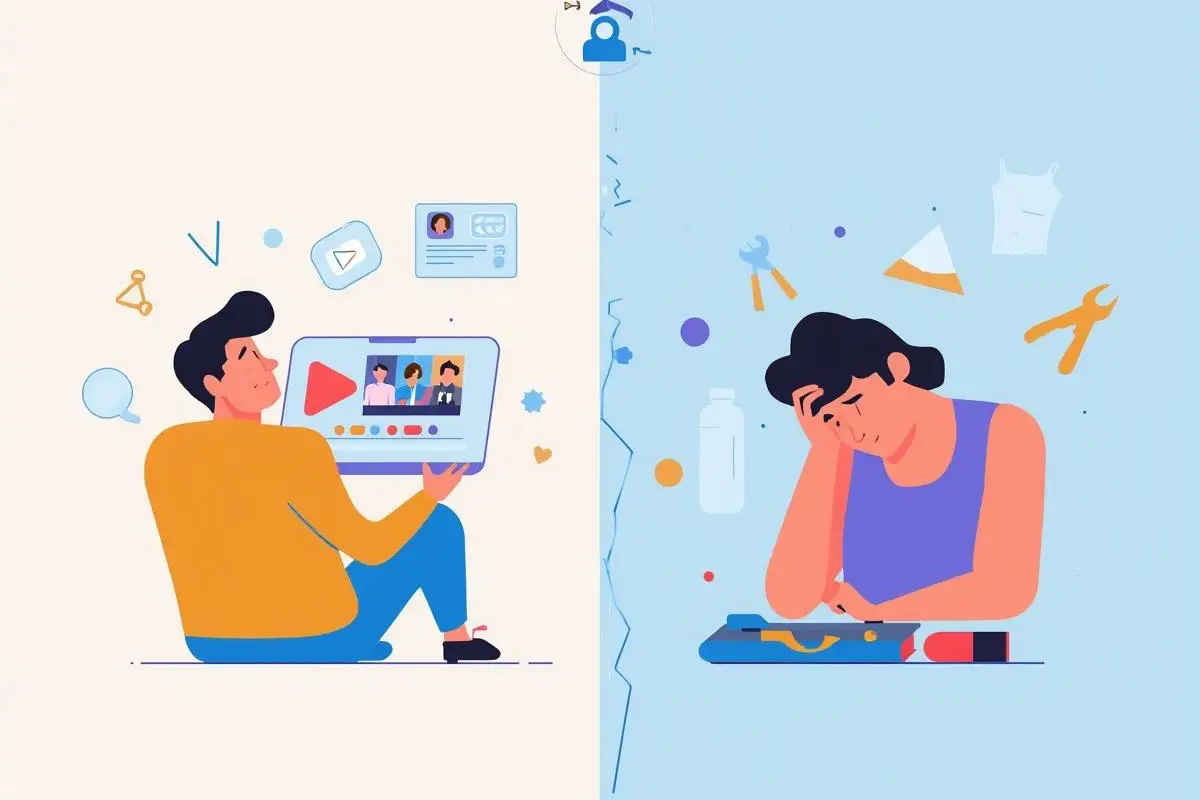
Video Learning vs Real-Life Application
What Happens During Video Learning
- They recognize information
- They follow steps easily
- They feel confident about what they learned
What Happens in Real-Life Situations
- They may struggle to apply the knowledge
- They hesitate when starting a task
- They need guidance to proceed
This highlights an important distinction:
👉 Understanding is not the same as ability
It also shows that the impact of screen time and learning depends more on how content is used than how long it is used.
Scientific Explanation
One key explanation is processing fluency-when information is presented in a clear and easy way, the brain interprets this ease as successful learning.
However, real learning requires effortful processes such as:
- making decisions
- figuring out next steps
- trying and correcting mistakes
These processes are essential for deeper cognitive development in children and for turning knowledge into usable skills.
Practical Examples
Example 1: Watching but not knowing how to start
A child watches a video showing how to make a simple paper craft and says, “I know how to do it.”
But when given the materials, they pause and do not know where to begin.
✔ What helps:
Instead of explaining, ask:
“What would you do first if you tried it yourself?”
Then wait.
This encourages the shift from watching to doing.
Example 2: Understanding without using
A child understands a concept while watching a video or using an app but does not use it in real situations.
✔ Why this happens:
In the video, the child is following—not generating or applying knowledge.
Example 3: Feeling something is easy
After watching several videos, a child says, “This is easy.”
But when trying it alone, they realize it is more difficult than expected.
✔ This shows:
Understanding does not equal skill.
Implications for Parents
These findings suggest that in child learning, ease is not always a sign of progress.
In fact, moments of hesitation, effort, and even mistakes are often signs that real learning is happening.
When it comes to screen time in children, videos should be seen as a starting point-not the final stage of learning.
Conclusion
Research shows that the video-based learning gap means video-based learning can support initial understanding, but it is not enough to build real-world skills on its own. Children need opportunities to apply what they have seen through real-life practice and interaction.
Ultimately, the difference between watching and doing is where meaningful learning takes place.
Sources