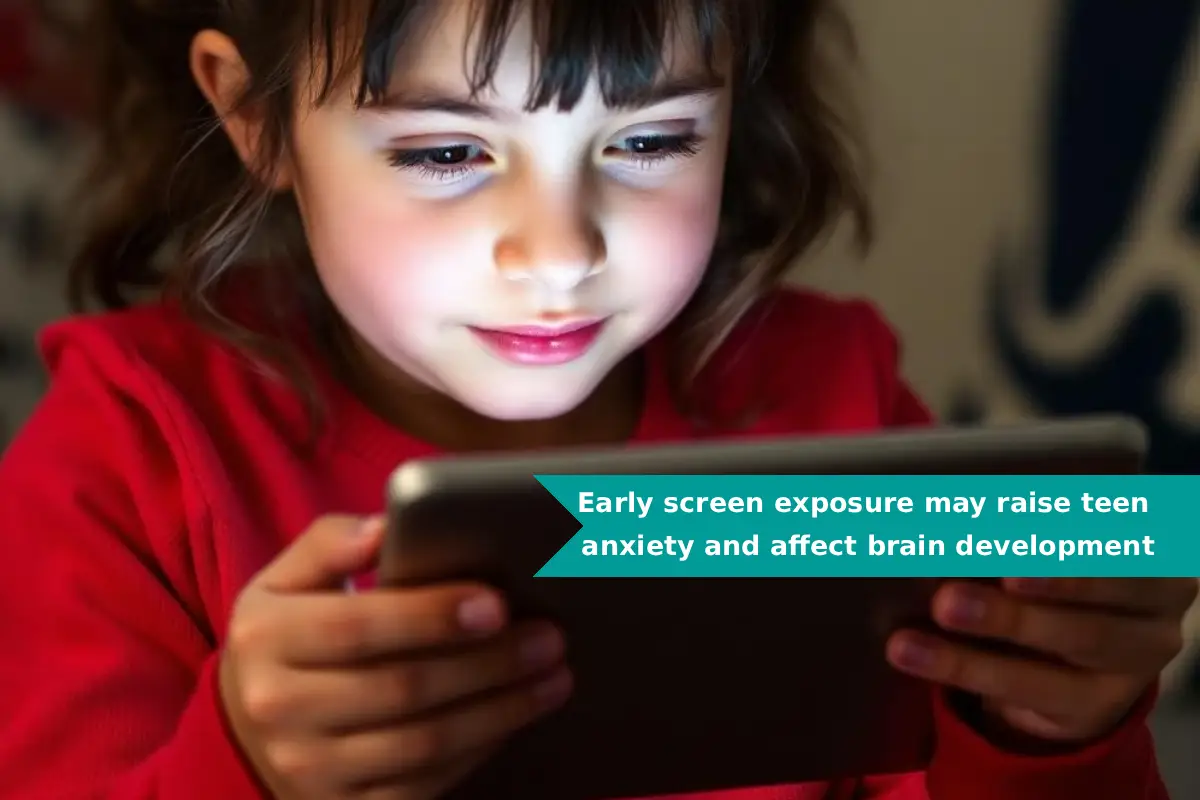
🔍 Does early and excessive screen use affect children’s brains and emotional health?
✍️ Source: Journal of Neuroscience & Developmental Psychology (Studies published 2024–2025)
💡 Key Insight
Recent longitudinal studies in neuroscience show that early and prolonged exposure to screens (TV, tablets, smartphones) is associated with long-term changes in brain development and a higher risk of anxiety during adolescence.
Children who spent significantly more time in front of screens before age 7 showed:
- Altered development in attention-control networks
- Reduced cognitive flexibility
- Higher levels of emotional sensitivity and anxiety in their teen years
Researchers emphasize that timing, duration, and content quality matter more than technology itself.
🧠 Why is this important for children?
Early childhood is a critical window for brain development. During this period, the brain forms neural pathways based on experience.
Excessive screen exposure may:
• Overstimulate visual processing systems
• Reduce opportunities for social interaction and physical play
• Limit deep attention and problem-solving practice
• Increase emotional reactivity over time
These changes may not be immediately visible, but they often appear later as attention difficulties, anxiety, or reduced stress tolerance.
🔬 What does neuroscience explain?
Brain imaging studies show that children with high early screen exposure demonstrate early specialization in visual and reward-based neural networks.
While specialization is not inherently negative, too much specialization too early can:
- Reduce overall brain flexibility
- Make it harder to shift attention
- Increase dependence on fast stimulation
This can make real-world environments—like classrooms—feel slower, more demanding, and emotionally overwhelming.
😟 How is screen time linked to teen anxiety?
Teen anxiety is influenced by more than school pressure or social media. Early digital habits shape how the nervous system regulates stress.
Research suggests that:
• Fast digital stimulation conditions the brain to expect constant rewards
• Real-world challenges feel more stressful by comparison
• Reduced sleep quality intensifies emotional dysregulation
Over time, this combination can increase vulnerability to anxiety during adolescence.
💤 Sleep, screens, and emotional balance
Screen use—especially in the evening—can delay melatonin release, disrupting sleep cycles.
Poor sleep in children and teens is strongly linked to:
• Increased anxiety
• Lower emotional resilience
• Reduced learning and memory
• Higher irritability
Healthy sleep routines act as a protective buffer for emotional well-being.
🎯 How can parents and educators support healthy development?
✔️ Set age-appropriate screen limits (1–2 hours/day for school-age children)
✔️ Avoid screens at least one hour before bedtime
✔️ Encourage physical play, reading, and creative activities
✔️ Watch and discuss content together rather than passive viewing
✔️ Model balanced screen habits as adults
The goal is guided use, not total restriction.
🌱 Vatan Academy Perspective
At Vatan Academy, we believe child development goes beyond academics.
Healthy brains grow through:
- Balanced routines
- Emotional safety
- Active learning
- Thoughtful technology use
Small daily adjustments-like reducing early screen exposure-can have a measurable impact on long-term mental health and learning capacity.
📖 References
- Journal of Neuroscience (2025)
- Journal of Adolescent Health (2024)
- American Academy of Pediatrics-Media Use Guidelines
- World Health Organization – Child Development & Mental Health Reports