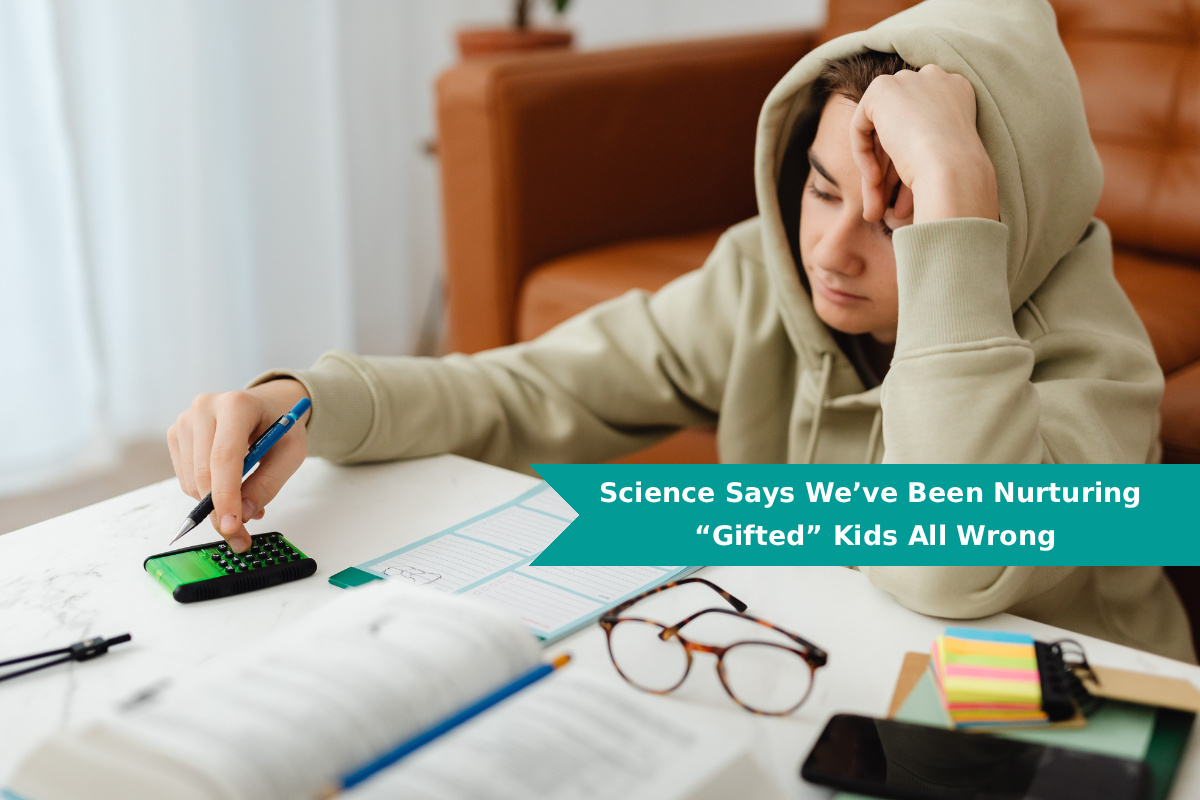
🔍 How Misunderstanding Giftedness Affects Children’s Growth & Learning
📅 Published: December 21, 2025
✍️ Sources: Developmental Science / Journal of Educational Psychology
💡 Key Takeaway
New research reveals that parents and educators have unintentionally been supporting “gifted” children in ways that hinder—not enhance—their long-term success. For decades, society has assumed that innate intelligence is the key to academic achievement. However, science now demonstrates that overemphasizing natural talent can reduce motivation, increase fear of failure, and limit a child’s willingness to take on challenges.
Instead, consistent evidence shows that effort, persistence, curiosity, and a love of learning are far more important predictors of academic and emotional growth.
Why It Matters
- Labeling a child as “gifted” can discourage them from embracing academic challenges.
- Many gifted children develop anxiety, perfectionism, or avoidance of difficult tasks.
- Modern educational models—especially in Canada—focus on growth mindset rather than fixed intelligence.
- Parents and teachers have a significant impact on how children perceive learning, effort, and success.
- Long-term achievement depends more on mindset and effective learning skills than on natural IQ.
When children grow up believing they must always be the best, they avoid classes or assignments that may expose their weaknesses. This avoidance harms both their confidence and future academic development.
🔬 Science Behind the Study
A 2025 study published in Developmental Science examined 180 children aged 9–13 during analytical tasks, logic puzzles, and academic challenges commonly used in advanced classrooms. The findings were striking:
- Children praised for ability (“You’re so smart!”) gave up sooner when tasks became difficult.
- Children praised for effort (“Your hard work helps you grow.”) showed greater motivation and stronger performance.
- fMRI imaging revealed that the effort-praised group displayed higher activation in learning-related brain regions during challenges.
Another study from the Journal of Educational Psychology found that children repeatedly labeled as “gifted” were more likely to experience performance anxiety and avoid activities that carried a risk of failure.
Together, these studies highlight a crucial truth:
Mindset shapes learning outcomes more than innate ability.
📚 Rethinking How We Support Gifted Children
For years, gifted children have been placed in advanced classes, given harder worksheets, or enrolled in special enrichment programs. While these opportunities can be helpful, research now shows that the way adults communicate expectations is even more important than the academic material itself.
✔️ Gifted children still need proper instruction
They must learn essential skills such as problem-solving, emotional regulation, time management, and effective studying.
✔️ Fear of failure undermines learning
Believing “I’m smart, so I must succeed easily” creates a fragile sense of self-worth.
✔️ Real growth happens through challenge
Learning deepens when children are encouraged to step outside their comfort zone.
✔️ Parents play a central role
If parents treat mistakes as learning opportunities rather than shortcomings, children become more resilient and confident.
🎯 Tips for Parents & Educators
✔️ 1. Praise effort, not intelligence
❌ “You’re so smart!”
✔️ “I love how hard you worked on this problem.”
✔️ 2. Introduce healthy challenges
Provide tasks that are slightly above the child’s comfort level to stimulate brain growth and active learning.
✔️ 3. Normalize mistakes
Remind children that all successful learners make mistakes—and that failure is a critical part of learning.
✔️ 4. Encourage inquiry-based learning
Let children explore topics they are curious about, conduct small research projects, and share findings.
✔️ 5. Explore different classes and activities
Math, chess, music, language learning, coding, and STEM programs all help strengthen cognitive skills.
✔️ 6. Build a question-friendly environment
Create a classroom or home setting where children feel safe asking questions without fear of judgment.
✔️ 7. Offer choice in learning
Allow children to choose projects, books, or study methods to increase motivation and ownership.
✔️ 8. Avoid comparisons
Each child grows at their own pace. Comparing them to others—especially siblings—harms motivation.
📖 Further Reading:
- Developmental Science (2025): Giftedness Through the Lens of Growth Mindset
- Journal of Educational Psychology (2024): Praise, Ability Labels, and Motivation